“Artificial Intelligence (AI) is like a child, who needs time to learn and adapt, whereas a typical IT system is like Buddha who knows everything about the problem it was supposed to solve.”
- Devesh Rajadhyax, Founder, Cere Labs.

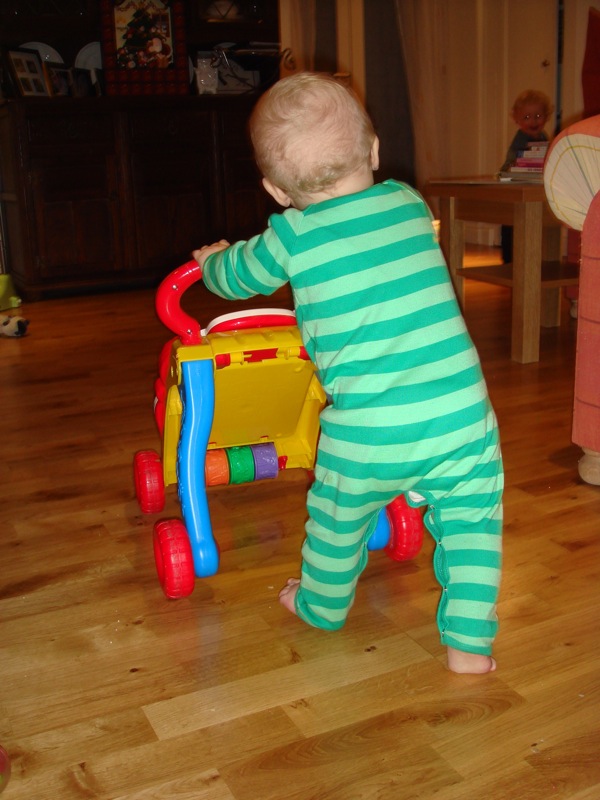
By Shaun MItchem - Diggy starts to learn to walk, CC BY 2.0, https://commons.wikimedia.org/w/index.php?curid=4762045
Let us in this post try to elaborate on this Buddha vs Child Paradigm which Devesh coined for
differentiating between conventional IT systems and AI. It is essential to know the difference because it
helps in building the right kind of attitude towards implementing AI systems. A typical IT system such as
ERP does the job for what it was implemented. It is assumed that it will solve the problem for what it was
made. Take for example an accounting system like Tally. It will help you to manage your accounts in highly
accurate manner. This system is like a Buddha, who is enlightened from the start. We can’t expect it to do
any mistakes (except the initial software bugs that are rectified). Or take for example a calculator.
A calculator will always give you 1+2 = 3, no matter you do this operation million times assuming that
the calculator is in a working condition. Thus we expect an IT system to work perfectly, and it does indeed.
differentiating between conventional IT systems and AI. It is essential to know the difference because it
helps in building the right kind of attitude towards implementing AI systems. A typical IT system such as
ERP does the job for what it was implemented. It is assumed that it will solve the problem for what it was
made. Take for example an accounting system like Tally. It will help you to manage your accounts in highly
accurate manner. This system is like a Buddha, who is enlightened from the start. We can’t expect it to do
any mistakes (except the initial software bugs that are rectified). Or take for example a calculator.
A calculator will always give you 1+2 = 3, no matter you do this operation million times assuming that
the calculator is in a working condition. Thus we expect an IT system to work perfectly, and it does indeed.
But take an AI system. A typical AI system learns from data. Initially it is like a child, finding it difficult to
even crawl, but slowly and steadily it learns how to walk as it is exposed to more situations which in the
case of AI is more data. Maturity of an AI system comes with more and more exposure to data.
In the example of calculator, an AI system will get many examples such as 1+2 = 3, and over a period
of time it will learn how to perform addition. Initially it might fail to predict 3, but it will come closer and
closer to 3.
even crawl, but slowly and steadily it learns how to walk as it is exposed to more situations which in the
case of AI is more data. Maturity of an AI system comes with more and more exposure to data.
In the example of calculator, an AI system will get many examples such as 1+2 = 3, and over a period
of time it will learn how to perform addition. Initially it might fail to predict 3, but it will come closer and
closer to 3.
As you have noticed there is a paradigm shift in understanding and using an AI system compared to an
IT system. Let us summarize few differences…
IT system. Let us summarize few differences…
IT System
|
AI System
|
Matured to solve the problem right from
the start it was supposed to. |
Keeps getting matured as it is exposed to
more data. |
Results are expected to be accurate.
|
Results keep improving.
|
Patience by IT executives is only required
till implementation. |
Patience is required throughout the lifetime
of the system. |
Mistakes in output can’t be tolerated.
|
Mistakes in output can be tolerated.
|
100% accuracy.
|
Accuracy tries to reach 100%, but is
mostly probabilistic. |
AI systems are the only option to solve problems which are not well defined, such as prediction or
anomaly. That’s why people tolerate its childish behavior.
anomaly. That’s why people tolerate its childish behavior.
Thus it is essential to understand this difference between an IT system and an AI system. It will help an
executive to assist AI researchers and engineers in achieving great results over a period of time.
executive to assist AI researchers and engineers in achieving great results over a period of time.
By,
Siddhesh Wagle,
Head of Research,
Cere Labs
Nice idea,keep sharing your ideas with us.i hope this information's will be helpful for the new learners.
ReplyDeleteSoftware Testing Training in Chennai
Software Training Institutes in Chennai
JAVA Training in Chennai
Python Training in Chennai
Big data training in chennai
Selenium Training in Chennai